Recently, while reading research on minoritized and endangered languages (an area I’m new to), I discovered the concept of “positionality.” While this is well known in the fields just mentioned, as well, I assume, by sociolinguists and anthropological linguists, since these are not my fields of specialization, I was unaware of how beneficial this can be for a linguist or any researcher investigating these kinds of languages and their speaking populations. In what follows, I discuss how positionality has been defined in previous work and how researchers like you and I can benefit from writing a Positionality Statement (PS), in which they reflect on how they are situated with respect to their object of study. I also describe the process of writing such a statement and then conclude by presenting a draft of my own positionality statement, for which I welcome feedback from the public.
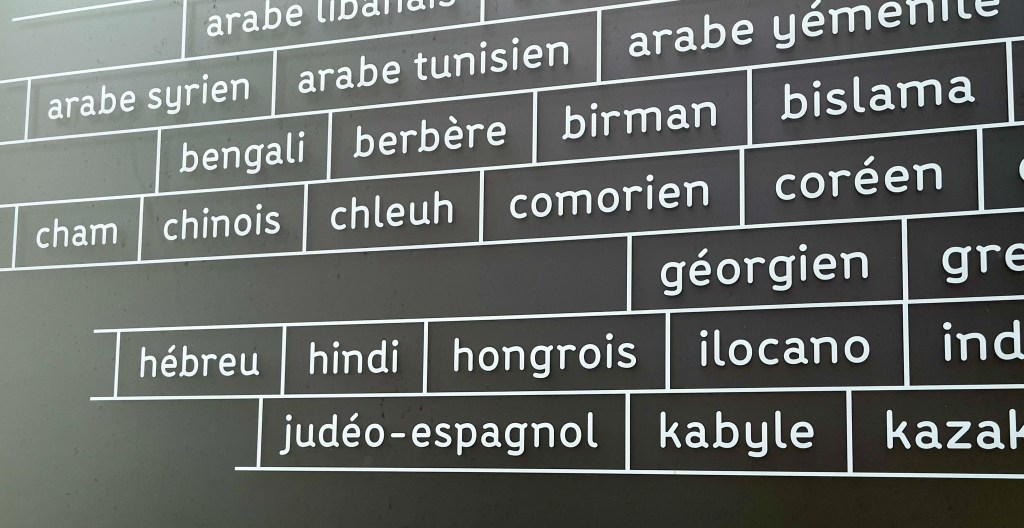
From the façade of the INALCO (Institut national des langues et civilisations orientales) in Paris. This is part of the list of languages offered at the institute. The one that caught my eye was judéo-espagnol or Judeo-Spanish, a variety I’ve long been fascinated by. (Photo taken by the author; September 6, 2024.)
————————
“Positionality” or “researcher stance” is how the researcher positions themselfwith respect to their research topic. It is based on the assumption that a researcher’s background and beliefs will affect the type of research they conduct and the conclusions they may draw from it. For example, as a non-indigenous person studying an indigenous language (an outsider), there are certain aspects of my identity and lived experiences that influence my approach to the language, whether I am aware of them or not. To determine one’s positionality, they need to reflect on their identity and how it relates to the object of study. Writing a positionality statement is a way of accomplishing this.
As mentioned, positionality is a concept that’s new to me. I suspect that linguists trained in a more anthropological approach are typically exposed to it in grad school, but for formal syntacticians like me, this is not the case. This is because syntacticians of the generativist persuasion focus on investigating language as an abstract system, which can lead some of us to us separating it from the people who speak the language. In fact, this is a common criticism of syntacticians I have frequently heard from my sociolinguist friends, which I believe does have some validity. In fact, considering our positionality is a good way to avoid this accusation, which is why I recommend my fellow syntacticians consider writing a positionality statement. For one, it is a useful tool to help us reevaluate our motives, especially when investigating minoritized and endangered languages. It raises the question as to why are we doing this work? For prestige? Financial or material compensation? It also forces us to confront more difficult questions such as whether we should be doing this kind of research at all? For example, is it our place (if we’re an outsider) to ask the kinds of questions we’re asking? Are we inviting ourselves into space that is not our own? And who is benefitting from this research other than the two or three academics who may read it when it’s published?
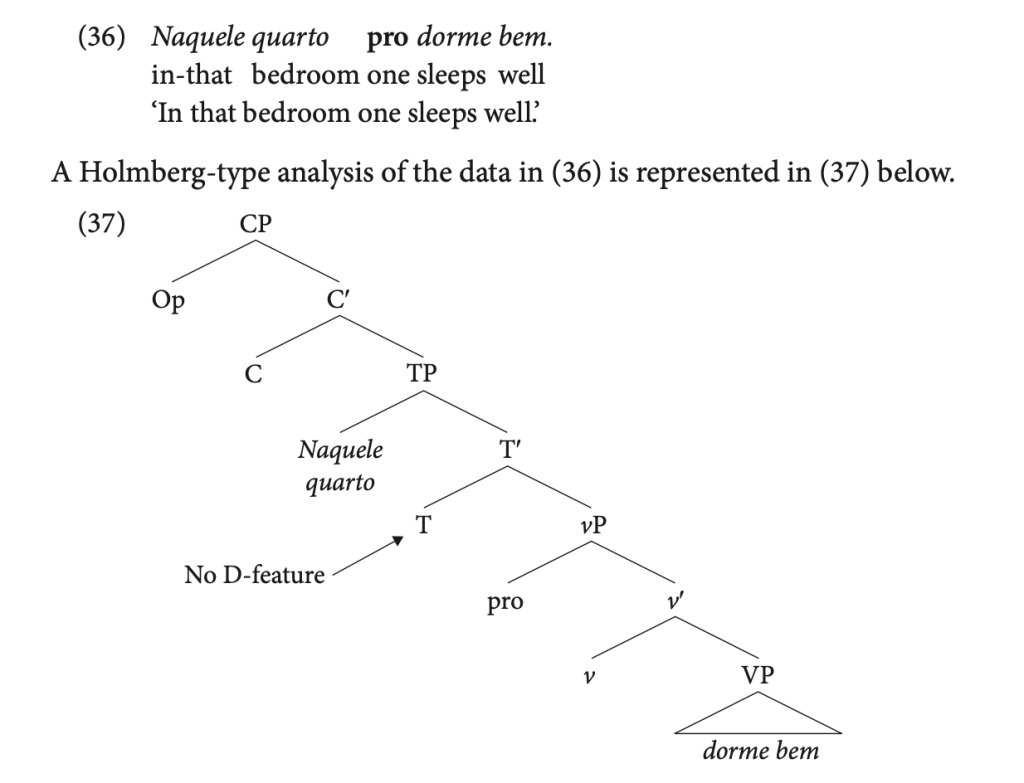
A syntax tree from my 2018 book chapter, ‘Licensing conditions on null generic subjects in Spanish.’ We syntacticians sometimes get caught up in theory and abstract away from the human side of linguistic research.
————————
At this point, you may be asking yourself: Should I write a PS? Interestingly, this was the question a young linguist recently asked me when I presented some research on ʻōlelo Hawaiʻi (Hawaiian language) at Université Paris Cité. This individual is investigating a language spoken in Eritrea and Ethopia and, while it is not endangered, the researcher is an outsider to the community, hence the relevance of the question. By way of answering, I referred them to the following rule from Charity Hudley et al (2024:239):
The PS is the perfect document in which to carry out this “explicit discussion.”
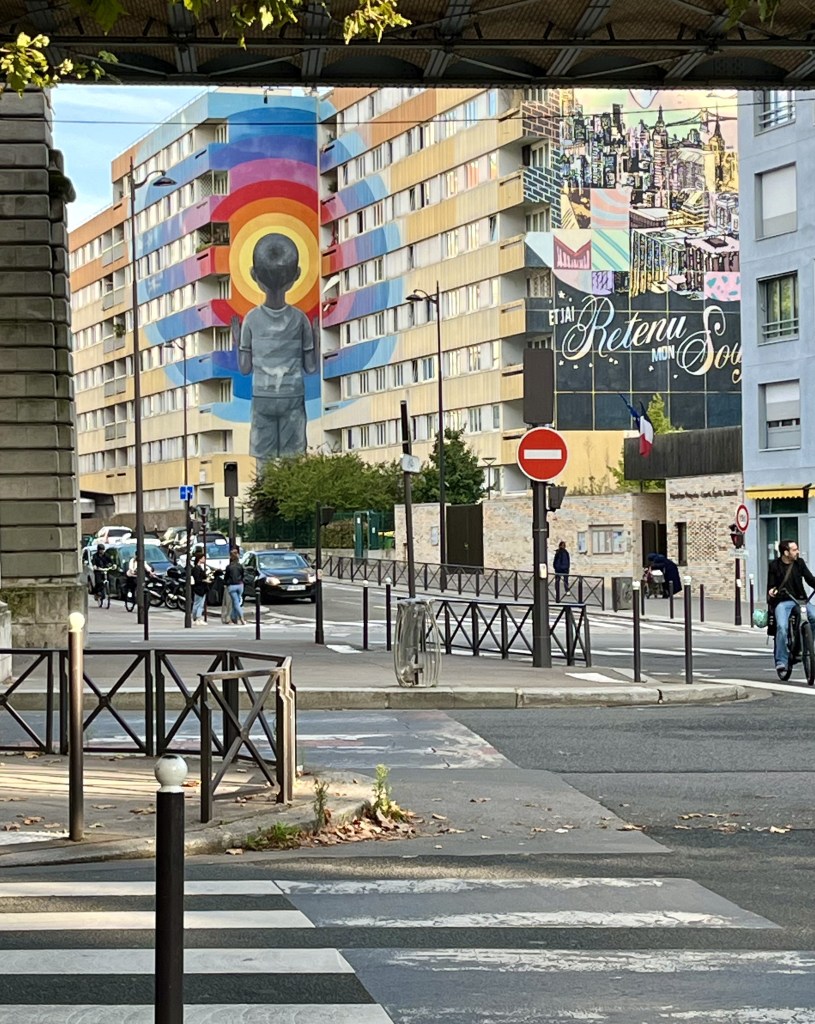
The view from a morning stroll in Paris, 13th arrondissement, heading towards Université Paris Cité from my hotel. (Photo by the author, September 6, 2024.)
QUESTIONS FROM HOMAN (2023) TO GUIDE THE WRITING OF A POSITIONALITY STATEMENT
1. What are my different social identities and how significant is each identity to my work? Social identities can include, but are not limited to, gender, race, nationality, sexual orientation, age, social class, religion, dis/ability and so on.
2. What experiences do I have? How have they shaped who I am professionally?
3. In what discipline did I train? What role did my discipline play in establishing dominant worldviews? What role do I play in this work? In what ways do I challenge or divest from some of these practices? Why or why not?
4. What are my values and what do I hope to achieve through my work?
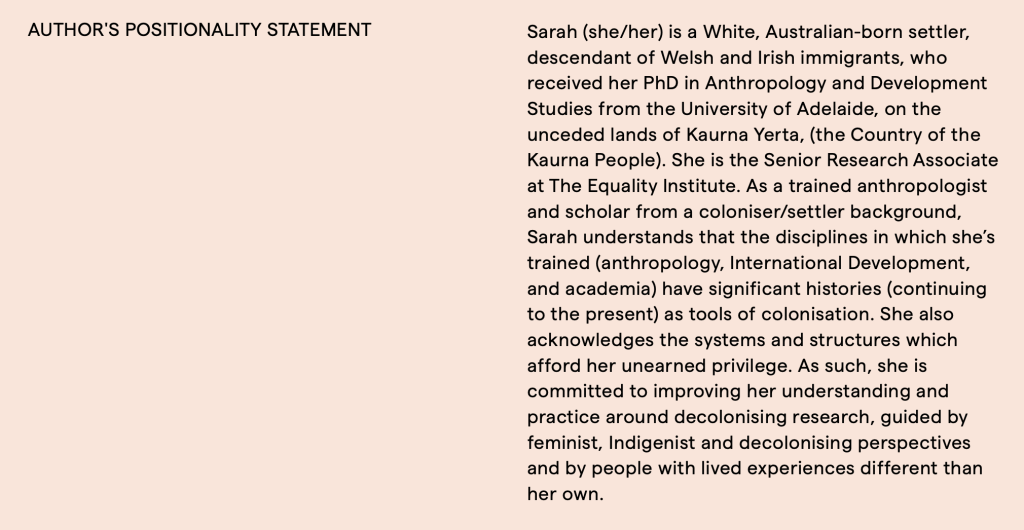
Homan’s (2023) Positionality Statement vis-à-vis her anthropological research and writing.
———————–
Another great resource, especially for my fellow syntacticians, is Gibson et al (2024), which addresses our field specifically and approaches to decolonizing syntax. These authors also provide a series of questions that can guide the PS writing process. For research methodology specifically, see pages 233 to 234.
Given my outsider status as a researcher on ʻōlelo Hawaiʻi, I have composed by own PS which I present here as a draft. As this is a work in progress, I’m happy to hear constructive feedback, especially from those with more expertise in this area than myself.
Charity Hudley, Anne H., Mallinson, Christine, and Bucholtz, Mary (2024). Decolonizing Linguistics. Oxford: Oxford University Press.
Gibson, Hannah, Jerro, Kyle, Namboodiripad, Savithry, and Riedel, Kristina (2024). Towards a Decolonial Syntax: Research, Teaching, Publishing. In Charity Hudley et al (eds), Decolonizing Linguistics. Oxford: Oxford University Press, 219-243.
Maddox, M. (2018). Licensing conditions on null generic subjects in Spanish. In Repetti, Lori, and Ordóñez, Francisco (eds), Romance Languages and Linguistic Theory 14: Selected papers from the 46th Linguistic Symposium on Romance Languages (LSRL), Stony Brook, NY. Amsterdam: John Benjamins Publishing Company, 185-199.
Other work on positionality:
Bourke, Brian (2014). Positionality: Reflecting on the Research Process. The Qualitative Report 19:1-9.
Holmes, Andrew Gary Darwin (2020). Researcher Positionality: A Consideration of Its Influence and Place in Qualitative Research – A New Researcher Guide. Shanlax International Journal of Education 8:1-10.
Lin, Angel (2015). Researcher Positionality. In Hult, Francis M., and Cassels Johnson, David (eds), Research Methods in Language Policy and Planning: A Practice Guide. London: Routledge, 21-32.
For this blog entry I decided to do a little French-to-English translating. I thought it might be interesting to present my process and then give a little linguistic commentary. Why French? Well, we’re traveling to Paris soon and I thought it’d be good to brush up on my French, which is not my strongest language (I’d say I’m an advanced speaker but not near-native proficient). For this translation I’ve chosen the song, Little Dolls by Indochine, because I like running to it in the Spring, so I’ve been hearing it a lot lately. If this piece gets any traction I might make this a regular entry and include other languages like Spanish, Latin, Italian, and a variety of different texts other than just pop music, which would be hard for Latin anyway since archeologists have yet to find any cassette-tapes from that era.
Anyhow, the format for this entry is as follows: 1) background on the band, Indochine; 2) a presentation of my own translation and problems I ran into; 3) a comparison with a translation by Google; 4) brief linguistic commentary focused on French first-person plural variation.
The front side of my well-worn copy of Indochine’s concert film from 2003. It’s PAL format so I had to buy a non-regional DVD player to watch. Yes, I’m that kind of fan ;). (Photo by MM)
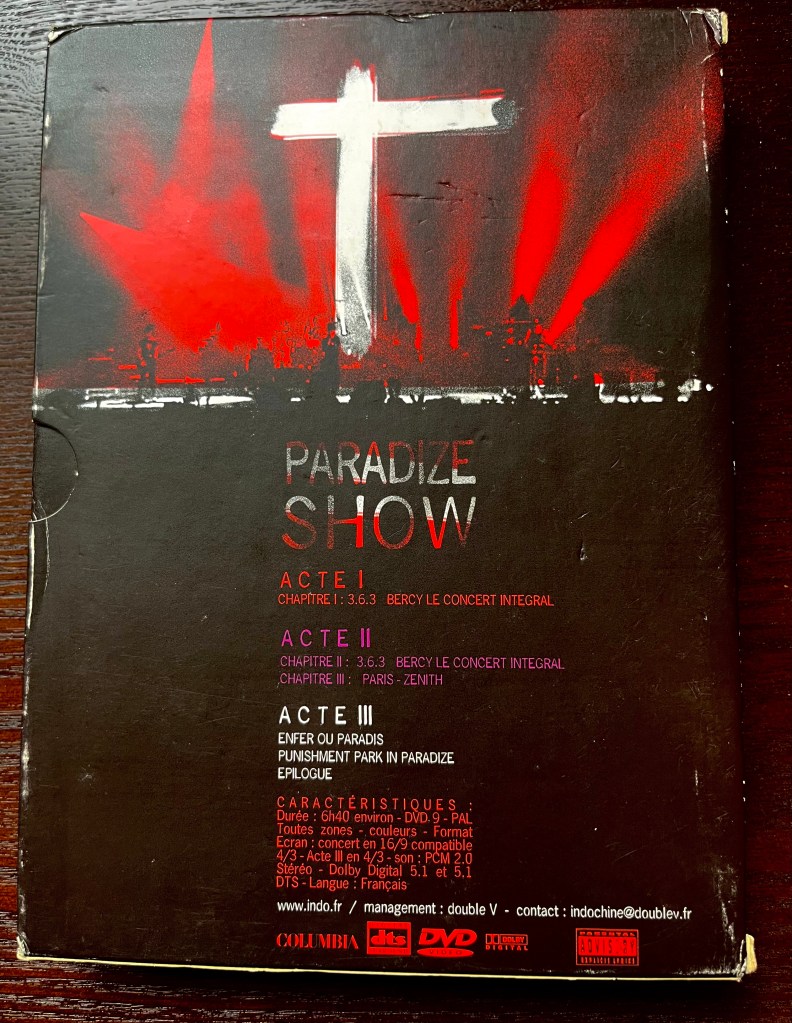
The reverse side of the DVD. (Photo by MM)
Some background.
If you did not experience your coming-of-age in France in the mid-1980s (like I did), then you may not know of the band under consideration here. Indochine was formed 1981 in Paris, basically when electronic pop was gaining momentum. Their most popular early songs are L’aventurier (1982) and 3e sexe (1985), both of which may get their own translation treatment here eventually. Their early work is very reminiscent of early Depeche Mode, probably by no coincidence since they started around the same time. I first discovered Indochine in college via iTunes (that’s what we called it back in those days), when I started studying French. I was looking for some French pop music to listen to and since I was a big DM fan already, Indochine popped up as a recommendation. The first album I listened to was Paradize (2002), which appealed to me because of the religious imagery but also the sexual and sometimes dark lyric material. After that I was pretty much hooked. Although I have yet to see them live, I’d love to do so someday.
The song I discuss below, Little Dolls, is from their 2009 album, Le république des meteors, which I always feel like listening to when spring comes around. You can watch the video for Little Dolls here: Youtube. The album is full of bangers, like Go Rimbaud Go! and Le lac. Side note: a special version of this album includes the band’s cover of Dead or Alive’s famous 1985 track, You spin me round (like a record), which is well worth a listen. Anyhow, I’m not a music critic, so let’s move on to something more language-oriented.
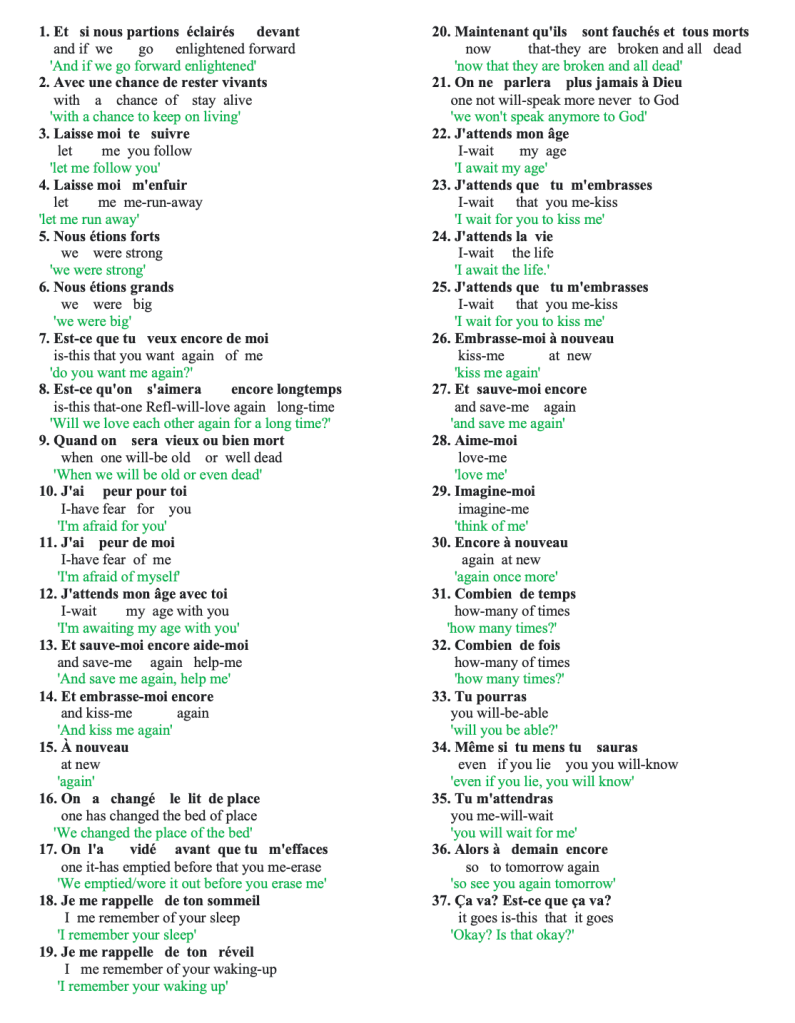
My translation.
The lyrics were composed Indochine’s lead singer, Nicolas Sirkis, who also wrote the music along with Olivier Gérard and Marc Éliard. As with many pop songs, the language isn’t overly complicated here, but there are some challenges I ran into when rendering it into English. For this translation, I copied the lyrics from online and then went line by line, glossing it literally and afterward putting into somewhat more natural English. I also inserted line numbers so that I can reference them in the discussion. I’m not attempting to reproduce meter here or even make an eloquent translation. Rather, the goal is just to understand the lyrics at a base-level, and maybe learn some new vocabulary. And here it is:
Most lines translated pretty easily, like line 3: Let me follow you. However, there were at least three problems I’d like to present here. First, consider line 12 in (1) below.
(1) J’attends mon âge avec toi.
I-wait my age with you
‘I’m awaiting my age with you.’ (l. 12)
I think I’m missing something idiomatic. The verb attendre is wait or wait for something and âge is like its English cognate. However, what does it mean to await one’s age with someone? It might be something like ‘I’m waiting to grow old with you’, but I’m not sure. Anyhow, this line is repeated several times throughout the song, so if you reading this have a better rendition, I’d love to hear it.
The next issue I ran into occurs in line 16.
(2) On a changé le lit de place.
one has changed the bed of place
‘We changed the place of the bed.’ (l. 16)
The problem here is the phrase le lit de place. According to wordreference.com, changer de place can mean to move, move seats, or trade places with. So, one meaning might be something like ‘we switched places with our bed’, which I think is referring to the frequency of sexual intimacy in this relationship. And the next line also refers to what’s going on in bed.
(3) On l’a vidé avant que tu m’effaces.
one it-has emptied before that you me-erase
‘We emptied/wore it out before you erase me.’ (l. 17)
This verb vider can mean to empty out but it can also mean vacate or even wear out. I’m going to opt for wear out, given the aforementioned frequent sexual relations. This gives us: ‘We wore it out before you erase me,’ the erasing here being the end of the relationship.
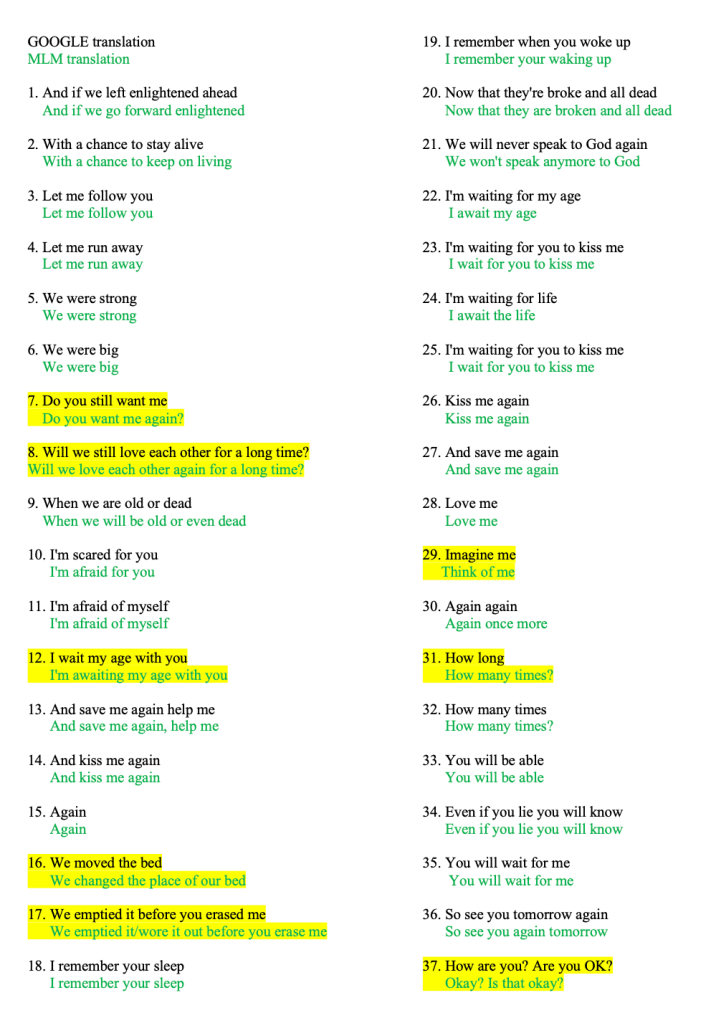
Google translation.
Okay, so as anyone student in French 101 or Spanish 101 or any language 101 course knows, nowadays Google translation can do most of the work for you. However, as anyone who has taught French 101 or Spanish 101, etc., knows, it is not perfect (at least not yet). So, let’s compare with Google came up with and how I translated. You can see below both translations, with Google’s in black text and mine in green.
The good news is that both are similar, so I’m at least as good as Google, and vice versa, but I will make a couple of self-criticisms here. First, in lines 7 and 8, I translated encore as again where still actually makes more sense. So, Google got me there. However, in line 12, we came up with more or less the same rendering (4), which I think still sounds odd.
(4) a. I wait my age with you b. I’m awaiting my age with you
Furthermore, in line 29, Google translated imaginer with the cognate English imagine while I chose think. I’m not sure which is better here, but think does sound a little more natural. If we compare lines 31 and 32, Google again did a better job in reflecting the French. While I translated both lines the same as ‘how many times’, suggesting repetition of the same word, the French uses two different words for time, temps and fois. Google’s translation reflects this with how long and how many times. And one more difference but not necessarily an improvement on Google’s part is line 37. Notice that in line 36, the speaker is saying goodbye to their interlocutor. In line 37, the French is: Ça va? Est-ce que ça va? Google has this as: How are you? Are you okay? I think that is kind of weird given the parting that was just stated in the previous line. Thus, I rendered it: Okay? Is that okay? The intention here is that the speaker is asking permission to see their lover again the next day, which I think makes more sense, at least on my interpretation of the lyrical content.
Some linguistic observations.
Moving on from translation, let’s do some linguistics. The French used here is standardized, which is not surprising given the lyricist’s background. However, there is one linguistic feature that stands out; i.e., variation in first-person plural expression. This is a well-known phenomenon in French, so I’m not making any novel claims here. To see how this pattern works, consider (5) below, which is my own constructed data, and not from the lyrics.
(5) a. Nous allons au bureau tous les jours.
we go.1P to-the office all the days
b. On va au bureau tous les jours.
one goes to-the office all the days
‘We go to the office every day.’
Notice that both versions of (5) can be interpreted with the subject as we, which is first-person plural. While (5a) has the expected first-person plural subject pronoun nous (equivalent to English we), (5b) has a different pronoun on, derived from the Latin pronoun HŌMO, originally meaning man. This on often receives the first-plural interpretation in (5b), but it can also have a generic reading, according to which the subject would refer to people in general, including the speaker, going to the office every day. For more on French generic on see Maddox (2019:32ff) and references therein.
As mentioned, the nous/on variation in (5) is so well-known that it is even mentioned in prescriptive grammars.1 For example, Judge & Healey (1995:72) refer to the generic use of on as the “real” indefinite and the first-person plural use of on as the “false” indefinite, and proscribe this false use from written language stating that “…only the ‘real’ indefinite on is considered good style in formal written French.” However, as any linguist knows, synchronic variation in the informal, spoken register of a language often indicates historical change. In other words, grammatical patterns and forms we would avoid in writing an essay (under the influence of prescriptivism), are just evidence of a change-in-progress. In English, for example, children are taught in school not to end a sentence with a preposition; i.e., preposition stranding. Consider (6) below.
(6) a. I have a meeting at 9 but I don’t know who I’m meeting with.
b. I have a meeting at 9 but I don’t know with whom I’m meeting.
In (6a), the preposition with is the last word in the sentence, which is considered “incorrect” by your high school English teacher, who would prefer (6b). However, both are perfectly acceptable to any L1 speaker of English and thus grammatical, at least in the way modern descriptive linguists understand it “grammaticality.” In reality, (6b) is much rarer frequency-wise and thus (6a) is likely where the language is heading historically and eventually the no preposition-stranding rule might become obsolete even in the formal register. How does this relate to nous/on variation? In this case, on with first-person plural interpretation is much more frequent than nous. In fact, Fonseca-Greber & Waugh (2003:108) report a frequency of 99% for on versus 1% for nous in their corpus of conversational European French. Thus, speakers almost always opt for on over nous, which means nous is going the way of linguistic dinosaurs, which is okay. Language changes and life…uh…finds a way.
Let’s now apply all this to the Indochine lyrics. Do we see any evidence of nous/on variation in this song? While as a corpus it is admittedly limited in size, we do see some variation in first-person plural subject reference. In fact, in the first line we have nous.
(7) Et si nous partions éclairés devant.
and if we go enlightened forward
‘And if we go forward enlightened.’ (l. 1)
And in line 8, we have on with first-person plural interpretation.
(8) Est-ce qu’on s’aimera encore longtemps
is-this that-one Refl-will-love still long-time
‘Will we still love each other for a long time?’ (l. 8)
Throughout the lyrics, I count a total of eight first-person plural references; three with nous and five with on. Recall that the study mentioned above reported 99% preference for on. How does our little corpus compare? Out of the admittedly few first-person references, five out of eight (62.5%) are with on. This is not as drastic as what was found with conversational French, but it is still consistent in that on is the preferred variant. Thus, the nous/on variation typical of the spoken language is also reflected in pop music lyrics, though the distribution is not identical.
The predominance of on is expected since we’re dealing with informal language (register variation), though the distribution is also conditioned by other social and linguistic variables. For example, the most glaring explanation for the three tokens of nous in lines 1, 5, and 6 could be attributed to meter. While nous partions is three syllables, the parallel form on parte would be two syllables, especially when followed by éclairés with which it would presumably elide. Another linguistic factor could be verb form. Notice that all three instances of nous occur only with present subjunctive verb forms, while on only occurs with the passé composé and the simple future. Verb form is a typical conditioning factor we would take into account if we really wanted to do an in depth sociolinguistic/variationist study of Indochine’s lyrics. Finally, the lyricist might also be taking other factors into account when choosing between the two, including their own prejudices or preferences. Afterall, this is not spontaneous spoken language but rather intentionally composed, written language. It is interesting though that we start out with nous in lines 1, 5, and 6, and then all the other first-person plural references are with on in lines 8, 19, 16, 17, and 21.
So, there you have my translation and commentary on Indochine’s Little Dolls. There were more aspects of the translation I could discuss, but I think this piece is long enough. If you’ve gotten this far, thank you for reading. If you have any corrections or interesting observations on my translation or anything else, please add a comment. Merci pour votre attention!
References
Fonseca-Greber, Bonnie and Linda R. Waugh. 2003. The subject clitics of Conversational European French: Morphologization, grammatical change, and change in progress. In Rafael Núñez-Cedeño, Luis López and Richard Cameron (eds.), A Romance perspective on language knowledge and use: Selected papers from the 31st Linguistic Symposium on Romance Languages (LSRL), Chicago, 19-22 April 2001, p. 99-117. Amsterdam: John Benjamins.
Maddox, M. 2019. Cycles of agreement: Romance clitics in diachrony. Phd dissertation, University of Illinois at Urbana-Champagin.
It is clear that L1 non-linguist speakers are also aware of this variation, given the abundance of YouTube videos by French speakers advising non-native speakers to avoid nous at all costs if you want to sound more native. ↩︎
In honor of February being Hawaiian Language Month, Mahina ‘Ōlelo Hawai’i, I present here some information about the Hawaiian language that visitors may be unaware of. These are things I’ve learned as a student of the language, in the course of my linguistic research, and through my nearly twenty-years traveling to and living in the islands. Please note that I am writing this from the perspective of a non-Hawaiian (linguist) for non-Hawaiian visitors. Given that ‘ŌleloHawai’i is not my language and does not belong to me I am currently planning a follow up that will incorporate the kānaka maoli voice; i.e., what Hawaiians want visitors to know about their language.
#1: The Hawaiian language is endangered but NOT extinct.
Some visitors assume the Hawaiian language (ʻŌlelo Hawaiʻi) has met the same fate as other indigenous languages in the face of imperialist expansion; i.e., extinction. However, this is not true. In fact, Hawaiian is all around you when you come to the islands, both in written and spoken form. While it is obvious in its presence on street signs, ʻŌlelo Hawaiʻi (ʻŌH) is also taught in most schools, and spoken at home and in public. In fact, according to the State of Hawaii Data Book for 2022, ʻŌH is spoken at home by 25,800 individuals. This makes ʻŌH the sixth most non-English language spoken at home, after Ilocano, Tagalog, Japanese, Chinese, and Spanish. ʻŌH is also an official state language, though the extent to which this is implemented on the ground varies (Honolulu Civil Beat). While ʻŌH did go through a period of decline due to events discussed below, it appears to be stable, thanks to the revitalization movement.
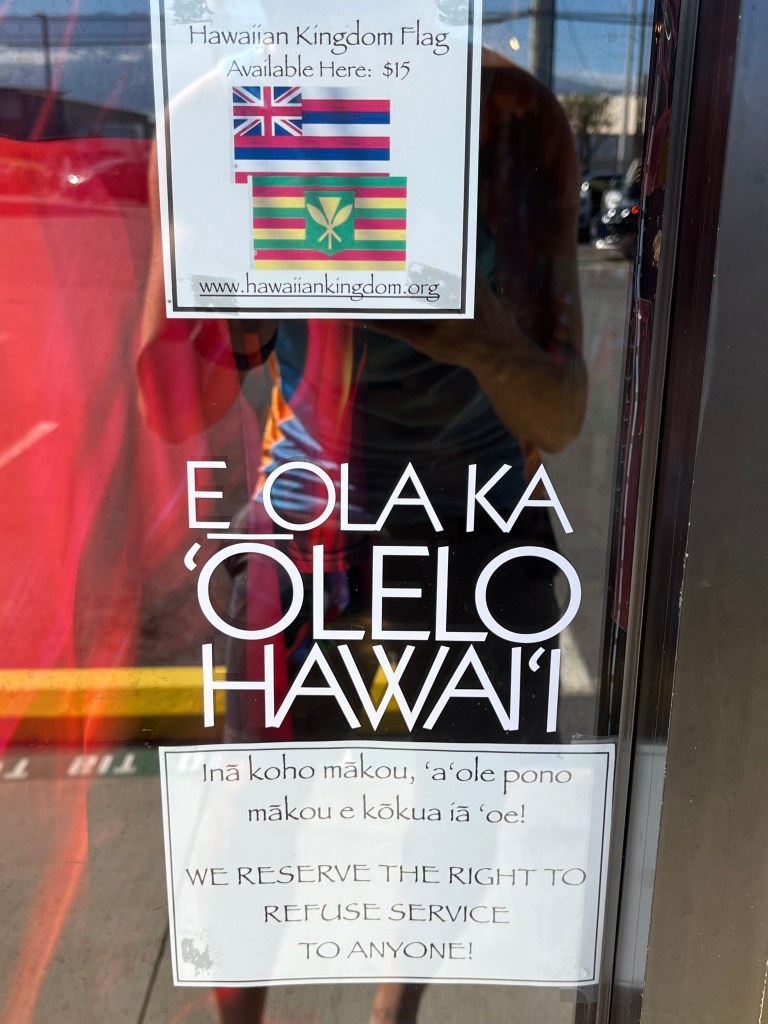
Some signage in ʻŌH at Rachel Ray’s Uʻi Gallery in Kahului. E ola ka ʻōlelo Hawaiʻi is the motto of the revitalization movement, meaning ʻThe Hawaiian language shall live!ʻ (Photo taken by the author; please ignore my reflection in the background.
#2: ʻŌH was suppressed and its speakers marginalized after the illegal overthrow of the Hawaiian Kingdom, leading to its decline.
The Hawaiian Kingdom was an independent nation until 1893, when a cabal of local businessmen initiated a coup, with the backing of the United States military.1 The true goal of many of the coup leaders was for Hawaiʻi to become part of the United States; i.e., annexation. However, that would not occur until 1900, when it became a US territory. In the meantime, the provisional government, which styled itself the “Republic of Hawaiʻi,” took measures to make Hawaiʻi more tempting to the United States for annexation. This affected ʻŌH in the form of Act 57, which made English the only language allowed for instruction in both public and private schools, effectively turning ʻŌH into a second-class language. Students were not allowed to speak it at school and it lost its previous status as the de facto prestige language of the islands. This negative stigma ended up in Hawaiian homes where the language was no longer passed on, so that future generations would not suffer the same types of punishment their parents suffered in school.
After a period of obsolescence, we can fast forward to the 1970s, when Hawaiians started to reassert their identity during the Second Hawaiian Renaissance. In the 1980s, many elder native speakers of ʻŌH (kūpuna) were passing away, which meant the language would disappear with them if countermeasures were not taken. This is when the Hawaiian Language Revitalization Movement developed, leading to the establishment of ʻŌH immersion schools. For more details see NeSmith (2005) and references therein. The main take away here for visitors to Hawaiʻi is that learning and propagating the language is part of a greater movement among Hawaiians to maintain their identity. Hawaiians are proud of their language! The revitalization and language-maintenance process is ongoing and visitors should do what they can to help support it.
#3: The Hawaiian language is NOT just a spoken language, with little to no literary tradition.
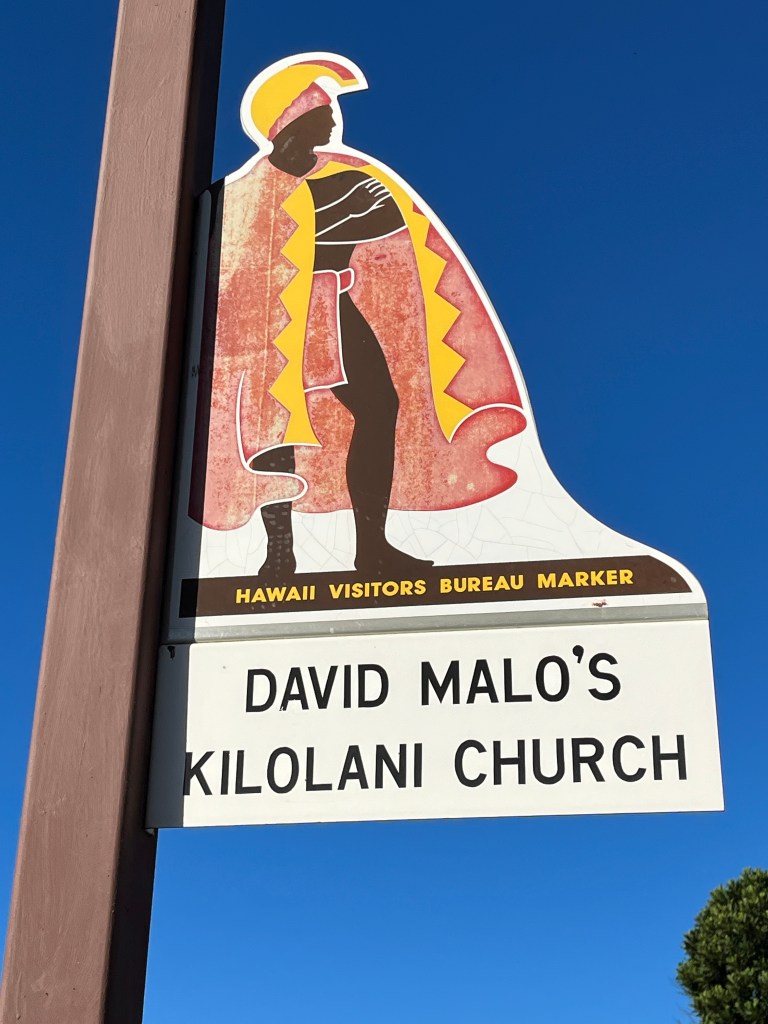
First of all, it is a common myth that languages that are not written down are “primitive” or “backward.” I return to this point in #4 below. As for ʻŌH, while it is true that it had no alphabet or textual culture prior to the arrival of the Protestant missionaries in 1820, once the tools were developed for it, Hawaiians were quick to learn, resulting in Hawaiʻi having one of the highest literacy rates in the world at the time (91-95% according to Kukahiko et al 2020). One of the texts first produced in ʻŌH was, of course, a translation of the Bible, Ka Baibala Hemolele, which was the joint effort of New England missionaries aided greatly by native speakers like David Malo, a very influential and early writer in ʻŌH.2 This Bible text is still read aloud in Hawaiian church services like the one I recently attended in Kihei, in the church founded by Malo himself, Trinity Episcopal By-the-Sea.
A sign on the grounds of Trinity Episcopal-by-the-Sea, indicating its historical significance. (Photo taken by the author.)
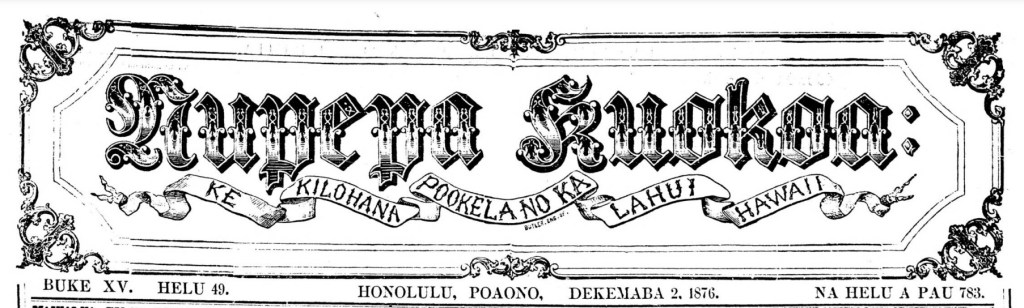
Another ʻŌH literary tradition is represented by the abundance of newspapers published in the language during the 19th and 20th centuries. Fortunately, much of these have been preserved and even digitized, and are available online via the Papakilo database. The history and influence of the newspaper tradition is studied in detail in Chapin (1996).
Heading of a Hawaiian newspaper, Ka Nupepa Kūʻokoʻa, published in Honolulu from 1861 to 1927. (Screenshot by the author via the Papakilo database.)
ʻŌH continues to be part of the periodical culture of the islands, as evidenced by the magazine Flux: The current of Hawaiʻi, which regularly features full length articles written entirely in ʻŌH (shoutout to N. Ha’alilio Solomon, Flux’s ‘ŌH editor).
#4: ʻŌH is not more “primitive” or “simpler” when compared to western languages.
This is another myth that non-linguists might have acquired as a result of western education. No serious linguist these days would claim that any language is more complex than the other. There are various problems with this idea, the most obvious being how to measure the level of complexity. How does one even define “complexity” here? If a language has more consonants than another, does that mean it’s more complex or sophisticated? No. In fact, ʻŌH has the same amount of vowels (five “long”, five “short”) as Classical Latin. So if we’re using vocalic inventory as a metric, at least with respect to vowels, we’ll have to place Cicero and David Malo on the same level.
I know what some of you former Latin and Greek students may be thinking: “Okay, but what about the declensions! And the conjugations! Does Hawaiian have that?!?” I know as students it was ingrained into us that a sophisticated language should be characterized by an overabundance of declensions to memorize. It is true that ʻŌH does not have this kind of rich morphology (fortunately for students of ʻŌH). However, again, this is an idea inherited in western society as a legacy of the classical and humanistic tradition. By the way, English has little to no nominal declension or verbal conjugation either, and yet we have all had to suffer through an English professor’s lectures on the ineffable eloquence of various British and American authors. However, while no one would claim that Shakespeare was not eloquent, this is a matter of writing style, not language. Shakespeare’s actual English was not more complex than any other language, including ʻŌH.
#5: Hawaiians appreciate it when visitors respect their language.
Have you ever had anyone mispronounce your name? If you’re of Anglo-American heritage and haven’t gotten out much, then maybe not. However, if you’ve ever been on the receiving end of this, it can be annoying if not offensive. And those of minoritized backgrounds usually suffer this the most. Even I have had this happen on more than one occasion. I once had a professor refer to me as Mr. Mad-doze. He must have wanted to treat the <x> in Maddox like the one in xylophone, which makes some sense by means of analogy, but in my family we have always pronounced it like Mad-docks.
Now imagine you’re part of a community whose home was taken over and culture and language suppressed. Wouldn’t you be irked if an outsider mangled the pronunciation of your hometown or your name? This is why it is important for visitors to learn to pronounce ʻŌH places and proper names more accurately. The good news is that ʻŌH is a highly phonetic language, by which I mean that each letter corresponds to roughly one sound, much like Spanish but much unlike French or English. Compare the following:
(1) February (English)
(2) Febrero (Spanish)
(3) Pepeluali (Hawaiian)
For English (1), I guarantee you’ve heard several different renditions. Is it ‘feb-roo-ary’ or ‘feb-yoo-ary?3‘ I think in the UK they say something like ‘Feb-ry’. How you pronounce it likely depends on your geographic origin and/or socioeconomic background. However, for (2), there is much less variation even though Spanish is spoken by something like 600 million people around the world. The worst I’ve heard a student do with (2) is pronounce the <r> like an English <r>, which is understandable when learning the language. Now consider (3). It’s pronounced almost exactly as written: pe-pe-loo-ah-lee. This is actually a loanword, but it still illustrates the point that ʻŌH is not as hard to pronounce as some might think.
Here are some common repeat offenders that tend to get butchered by visitors and even long-term transplants: Kāʻanapali, Lanaʻi, Molokaʻi. Most of the errors have to do with the ʻokina (ʻ), which is an actual consonant, not a diacritic or accent mark. The ʻokina is technically a glottal stop and even if you can’t produce it yourself, just keep in mind that it also separates syllables. That’s why Hawaiʻi is pronounced with three syllables: Ha-wai-ee, NOT Ha-wai. Now extend this to the other examples: La-nah-ee, NOT la-nai (which is another word but not the name of the island); Mo-lo-kah-ee, NOT Mo-lo-kai. Making this adjustment is a simple but effective way to respect the language and by extension the Hawaiian people.
Before concluding, one more example must be mentioned. If you ever find yourself on the north shore of Maui, around Pāʻia (another commonly misprononced town), you may end up at Hali’imaile, which has a nice general store/restaurant that I definitely recommend trying out. Unfortunately, the name of the village tends to cause difficulty, again in part because of the ʻokina. Haliʻimaile is pronounced: Hah-lee-ee-my-leh, NOT hiley-miley. I’m not sure why but this particular mispronunciation annoys me more than others.
Pronunciation aids are easy to come by. Look at any ABC Store and you’ll find basic Hawaiian phrasebooks that usually have a pronunciation guide. Also, the book, Island Wisdom, by Native Hawaiian and cultural advisor Kainoa Daines and Annie Daly has a basic intro for lay people, in the chapter on mo’olelo (stories). This book also has a ton of other useful cultural and historical information for non-Hawaiians. Another strategy to help with your pronunciation is to watch the local news while on island. The news reporters almost always pronounce place names and proper names correctly, probably because it’s network policy. Just listen and repeat.
And thereyou have five things to know about the Hawaiian language if you plan on visiting soon. Naturally, this list is not exclusive and there is much more to be said, but I’ll leave that for future posts. Also, respectful and insightful comments are welcomed. Aloha and safe travels!
References
Chapin, Helen Geracimos. 1996. Shaping history: The role of newspapers in Hawaiʻi. Honolulu: University of Hawaiʻi Press
Daines, Kainoa and Annie Daly. 2022. Island Wisdom: Hawaiian traditions and practices for a meaningful life. San Francisco: Chronicle Prism.
Daws, Gavan. 1968. Shoal of time: A history of the Hawaiian islands. Honolulu: University of Hawaiʻi Press.
Kukahiko, Kealiʻi, Pono Fernandez, Dawn Kauʻi Sang, Kamuela Yim, Anela Iwane, Kaʻanohiokalā Kalama-Macomber, Kuʻulei Makua, Karen Nakasone, Dana Tanigawa, Kāhea Kim, Leināʻala Cosma Reyes and Tristan Fleming-Nazara. 2020. Pūpūkahi i Holomua: A story of Hawaiian education and a theory of change. Encounters in Theory and History of Education 21: 175-212.
Lyon, Jeffrey. 2017. No ka Baibala Hemolele: The making of the Hawaiian Bible. Palapala 1:113-151.
NeSmith, R. Keao. 2005. Tūtū’s Hawaiian and the emergence of a neo Hawaiian language. ʻŌiwi Journal-A Native Hawaiian Journal. Honolulu: Kuleana ʻŌiwi Press.
The United States Congress issued a formal apology in 1993 via a joint resolution. However, there is still much work to be done to address the damage the overthrow inflicted on the Hawaiian people. ↩︎
The fascinating story of how the Baibala Hemolele project came about is described in detail in Lyon (2017). ↩︎
I’m fully aware that these pronunciations would be better represented in IPA, but I’m aiming this entry toward a broader, non-specialist, audience. ↩︎




 Matthew Maddox - Linguist